Orchestral-electo compositions based on archive recordings of shakespearian actors. This theater production is in German but the melodic material of the musical accompaniment is based on recordings of British actors found in archive recordings. The production was for the Akzent Festival in Duisburg, Germany. Director, Kevin Barz. More info on youtube.
Demokratische Sinfonie: Commission for orchestra and actors
Composition based on the voice-patterns of selected debates in German parlaiment. See youtube for more info.
Interview with director, Kevin Barz
Bauhaus Art Film: Noise-electro-acoustic composition
Opéra national de Lorraine
Êtes-vous amoureux ? Demo trailer.
Opera based on interviews and voice-melody.
University of Chicago guest artist (2021)
Canadian Language Museum Yiddish Curses and Blessings
The Music of Yiddish Blessings and Curses installation was a collaboration with the Ashkenaz Festival in Toronto. Paul Brody interviewed Yiddish speakers throughout the city to explore their favourite curses and blessings, as well as the stories and memories behind them.

Brody was expecting that the blessings and curses would reveal a treasure of Yiddish culture — the food, the suffering, the humour and irony — but what he also found was an underlying Yiddish vocal pattern to narrating hope and community. He discovered that as the Yiddish speakers, young and old, invoked the traditional Yiddish sayings, the emotionality in their voices revealed the musicality of ‘speaking Yiddish.’ Brody recalls:
I became fascinated by how my interviewee’s voice-melody often shifted from conversational to a melodic, almost singing voice, through the uttering of a blessing or a curse.
Brody uses these voice-melodies as a compositional basis for the project, blending documentary and artistic interpretations. In a broader sense, the sound installation explores the dialectic of traditional and spontaneity, formulaic and the fluctuating, sacred and secular.
Yiddish blessings and curses reveal a musical language that is uniquely Yiddish. During her interview, Miriam Borden explains, The words might not be in Yiddish, but the way of talking is Yiddish.
Drawing on his work with both contemporary Jewish music and radio documentaries, Brody creates a five-part suite for his sound installation: 1. Talking Yiddish 2. Bagel Hell 3. Curse Composition 4 Feeling Family 5 Belly Blessing
The final Toronto exhibition will add two more dimensions. Brody is asking musicians around the world to respond to his recordings of Yiddish blessings and curses with their own short musical improvisations based on the the voice-melodies of Yiddish blessings and curses. Visual contributions will come from Miriam Borden, a doctoral student at the Centre of Jewish Studies
at the University of Toronto. Portraits of the people who were interviewed for the project and key phrases will be displayed graphically.
Musicians on Part I Berlin-Vienna-Toronto klezmer scene: Alan Bern-accordion, Christian Dawid-clarinet, Daniel Weltlinger-violin, Peck-Kubaczek, Cynthia-cello, Benjy Fox-Rosen-bass & voice, Paul Brody-trumpet, trombone, Lorie Wolf-drums
Musicians on Part II who interpret the voice-voice-melodies
Dan Blacksberg -trombone, Daniel Kahn -voice, Joshua Horowitz -accordion, Brian Katz -guitar, Marilyn Lerner -piano, Frank London -trumpet, Sasha Lurje -voice, Benjy Fox Rosen -bass/voice
Cookie -Segelstein-violin, Eric Stein -Mandolin, Lorie Wolf -drums
Two generations of Toronto Yiddish speakers interviewed: Michael Wex, Shirley Kumove, Jack Newman, Helen Smolkin , Belva Spiel, Jordon Chad, Sarah Katz, Miriam Borden
Living Arts Theater, Munich Walk with Robert Johnson
Sound Art based Composition
City of Weimar Commission (2023)
Sound design for the new public space that is currently being created in the Altstadt (Historic area).
Storywalk Gleisdreieck (2022)
Storywalk Gleisdreieck was a commission from the city of Berlin (Dept. Gruen Berlin). It’s a collection of interviews from experts about the fascinating park history and nature. The musical accompaniment for the park stories is composed from sounds recorded in the park (Nightingales, skaters, fall leaves, basket balls, wind, trains, etc.)
As shown on the on online map link, there are stations around the park showing the QR codes and the topic. It’s a permanent part of the park!


……………………………………………………………………………………………………….
Museum fuer Kunst und Gewerbe Hamburg:
“Together! Die Neue Architektur der Gemeinschaft“ (2020)
Sound installation depicting the narrative of urban nature. This sound collage is part of an exhibit showing concepts of public space in growing cities.

Inclusion Work: Composer in Residence
Brody is composer in residence for the Utopia Ochestra, the first inclusive orchestra in Germany. He is also working with Kulturleben Berlin as the art event curator.
Brody is involved in three inclusion projects through the Kulturleben Berlin association (Verein), largely financed by Aktion Mensch. His main project curating art events for the program, Bühne frei! … schafft Chancen für Künstler:innen mit Behinderung (Clear the stage! … creating opportunities for artists with health conditions or impairments) This finances and helps to organize accomplished artists of all discaplines.
The biggest work so far has been with the art department of the well known Ramba Zamba Theater in Berlin. The next year has a number exciting events: a performative video with author and Afro-german queer actives, Katharina Oguntoye, a collaborative dance and painting exhibit featuring the visually impaired artist, Silja Korn and braille inspired artist, Jac Carley (also in collaboration with the Ernst Busch University of Theatre Arts Berlin). There ia also an electro-acoustic and theater workshop!
,https://kulturleben-berlin.de/buehne-frei-schafft-chancen-fuer-kuenstlerinnen-mit-behinderung/
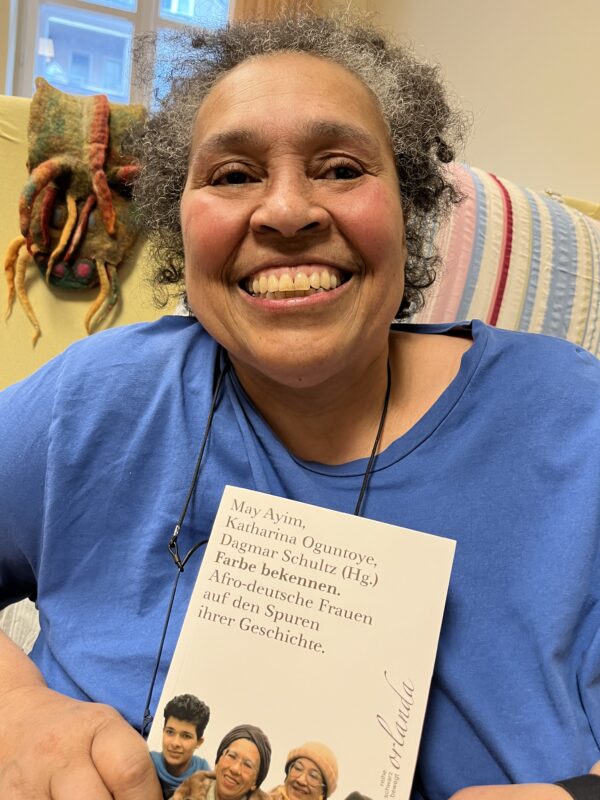

Katharina Oguntoye: Afro-German queer activist Jac Carley & Silja Korn Projects (Video below)
Ogentoye is writing an autobiographical text to be performed as a wheel chair-bed dance. It will include interviews with other people in the inclusion community.
GRIPS THEATER Berlin premiers: Composition Commissions: Utopia Orchestra: Berlin Suite (Part 2) Pablo Song Cycle

Premier, GRIPS Theater, Berlin, July, 2025 (Text to be translated in English soon!)
Wie klingt eigentlich die Berliner Schnauze? Im Frühlingskonzert des Utopia Orchesters können kleine und große Konzertbesucher*innen dies auf höchst musikalische und unterhaltsame Weise erkunden. Gespielt wird die Berliner Suite, ein sinfonisches Werk, das der amerikanische Komponist und sound artist, Paul Brody nach Anregungen der Musiker*innen eigens für das Utopia Orchester geschrieben hat.
Das Utopia Orchester gehört zur Werkstatt Utopia, dem inklusiven Musikprojekt des Vereins KulturLeben Berlin. Es lädt Menschen mit und ohne Behinderung zum gemeinsamen Musizieren ein. Im Mittelpunkt steht die Liebe zur Musik und die Freude am musikalischen Zusammenspiel.
Utopia Jazz Ensemble Inclusion band coached by Paul Brody
The inclusion band focuses on learning standard jazz/rock repertoire and improvisation.

Barenboim Foundation Boulez Saal
Webern from the Inside and Outside
A Sound Installation by Paul Brody
Videos and Explanation:
Video 1: Artist’s Talk at Boulez Saal.
Video 2: Sound installation.
Video 3: Selection of Videos from the 12 tone contributors.
Webern from the Inside and Outside
A Sound Installation by Paul Brody
(English translation of Webern letter fragments below)
PART I
Webern From the Inside
Fragments: Eine Andere Art von Liebe
The Webern sound installation grew out of Brody’s term as an Artist in Residence at the University of Virginia, when he coached students on combining audio and written archival material. Brody developed a presentation in which he mixed recorded passages of the letters of Anton Webern with fragments of the composer’s music processed in a sampler.
To Brody, Webern’s compositions contain a direct emotionality in their brevity and in their use of sound colors and textures as his primary compositional elements. He selected fragments from Webern’s letters that convey the breadth of the composer’s work: an artistic hunger for the depths of sound and a personal yearning for acceptance by those around him.
Brody recorded the letters and transcribed the speaker’s voice-melody–a method he has developed for using the musicality of a person’s voice as a base for compositions. The tone rows Brody derives with the technique are strongly influenced by the twelve-tone music of Webern and his teacher Schoenberg.
In this project Brody’s voice-melody composition is a kind of musical sketch–akin to a pencil drawing that can be filled in by musical colors and textures extracted from Webern’s works. While the spoken fragments of the letters create a narrative, the looped and sampled music conveys the essence of the composer’s sonic imagination.
A special thanks to Dr. Simone Hohmaier from the Staatliches Institut für Musikforschung Preußischer Kulturbesitz for helping research Webern’s letters.
Musicians: Asher Biemann- voice, Cesar Lerner- accordion, Rachel Susser- flute, Joel Rubin- clarinet, Gabriella Strümpel- cello, Paul Brody- trumpet, trombone, sampler.
PART II
Webern From the Outside
A twelve-tone row travels the world
In the second part of the Webern sound installation, Brody focuses on the concept of borders and space in relation to his music. Webern experienced the radical shift in musical boundaries that marked the first decades of the 20th century and later the shattering of socio-political borders after the two world wars. Webern dedicated the last 20 years of his life to the narrow confines of the twelve-tone row, which Brody explores as a kind of sonic home.
Brody sent Webern’s quintessential twelve-tone row from the Concerto for Nine Instruments, Op. 24 to musicians in places as far-flung as Buenos Aires, San Francisco, Warsaw, and Berlin, where Brody has lived for 25 years. He asked musicians ranging from a Toronto grammar school choir to established soloists such as Elliott Sharp and Roy Nathanson, to interpret the row.
The assignment: use any instrument at any tempo, but finish in less than a minute. The submissions included everything from guitars and cellos to a tractor, a telephone, and a truck horn. While Brody’s initial intention was to play the compositions sequentially, he found that some worked together harmonically and others formed a dialogue by overlapping.
Sound Installation Artist/Composer: Paul Brody
Brody’s recordings have been produced by John Zorn for Tzadik Records. His sound installations have been featured at the Jewish Museum Berlin and the Opera Department of the Munich Kammerspiele, where he was 2017 Artist in Residence. In 2018 he was a guest artist at the University of Rhode Island and Artist in Residence at the University of Virginia. His documentary radio pieces can be heard on Germany’s WDR. For more of Brody’s work, please visit www.paulbrody.net
Part II Contributors in order of appearance
Contributors In order of appearance (Many musical contributions. have been combined together)
Concerto for 9 Instruments 12 tone row excerpt (Pierre Boulez Ensemble)
Toronto school choir workshop, Toronto, Canada
Petteri Pitko, harpsichord, Helsinki, Finnland
Andromeda Mega Express Orchestra Mitglieder, Berlin, Germany
Jannis Lilge- Baglamas, eine griechische Oktavbouzuki, Berlin
Hassan Akkouch-voice, Munich
Finnish Baroque Orchestra- Helsinki, Finnland
Michael Rodach-guitar, Berlin, Germany
The Embassy Singers, Berlin
Signumquartett- Cologne, Germany
Elliott Sharp-guitar, New York, USA
Roy Nathanson-Sax, New York, USA
Pamela Stickney-Theremin, Vienna, Austria
Jan Roder-bass, Berlin
Christian Kögel-guitar, Berlin
Mark Rubin-bass, Mandoline, New Orleans, USA
Melina Moguilevsky- singer, Buenos Aires, Argentina
Jan Tengler-bass, Cologne, Germany
Joely & Oliver- Liedermacher, Munich
e la luna ? Italian jazz, Berlin
Maximilian Gallup- electronics, Berlin
Adrian Receanu – caval, fluier, clarinet, Paris, France
Gerald Meier-Trombone, Berlin
Bartosz Mikołaj Nazaruk-drums, Warsaw, Poland
Daniel Dorsch-Ele Meta Phone, Berlin
Aubrey Beal- Sampler, Alabama, USA.
Sebastian Carewe Piano Trio, Berlin
Verena Wehling-viola, Berlin
Milena Kipfmüller & Klaus Janek, voice, electronic, bass, Berlin,
Joel Rubin-clarinet, Virginia, USA
Jay Rizzetto-trumpet, California, USA
Raven Chacon- guitar, Navajo Nation, USA
Vivien Lee-voice, Hong Kong/Berlin
Lukas Ligeti- percussion, Johannesburg, South Africa
Julie Sassoon-piano, Berlin
Elsa Kopf- singer/songwriter, Paris, France
Mae McKenna, singer, Coatbridge, Scotland
Ilya Shneyveys, synthesiser, Riga, Latvia
Holger Marks (tenor) & Philip Mayers (piano) Berlin
…….
VIDEOS
Daniel Dorsch-Ele Meta Phone, Berlin,
Raven Chacon -guitar, Navajo Nation, USA
Hazel Leach’s Composer’s Orchestra Berlin, Germany
Oli Bott-percussion, Berlin, Germany
Brasstastix, trombone choir, Berlin
Vivien Lee-voice, Hong Kong/Berlin
Ilya Shneyveys, synthesiser, Riga, Latvia
Milena Kipfmüller & Klaus Janek, voice, electronic, bass, Berlin, GermanyRoman Josef Britschgi-bass, art, Wilen im Kanton Obwalden,Switzerland
Jan Roder-bass, Berlin
Pamela Stickney-Theremin, Vienna, Austria
Elsa Kopf- singer/songwriter, Paris, France
Michael Rodach-guitar, Berlin, Germany
Christian Kögel-guitar, Berlin
e la luna ? Italian jazz, Berlin
Webern’s Letter Fragments Translated into English
-Of course I always think of Mahler. One can learn a lot from him. I’d like to be able to concentrate on my own things. I do not want to live a biography – but think of Beethoven. And then another 1000 reasons come to mind. I can’t name all of them (health, my daily routine, family). But I’m often confused – to influenced by ambition… ambition! I have to let go of this earthly pursuit.
-It was wonderful in Berlin. I don’t now if I wrote to you about it. The performance beautiful! And the piece, the sound, the composition, the darkness, it was glorious!
-It’s terrible that I can never talk to Schoenberg. Those were the best hours. When I went for a walk with him. Especially this time of year, in September.
-I can’t find anything that’s bright, nothing that comforts me. And that makes me feel fruitless. It makes me sick. And that’s why I have to give up the theater. It’s a mystery to me how Mahler could stand it. Maybe because he started at a young age.
-Are you getting together with Kokoschka? You should meet. I think such a friendship is wonderful. It would be great if all the people who are doing things in this city could get together. Schoenberg, Klimt, Altenberg, Loos, Kraus, us, Kokoschka and many others. I mean, we are nothing. But we still belong to it.
-Schoenberg once said to me that there is a completely different kind of love than this literary orientated passion. There’s a calm …mostly tender… loving relationship. This is how I felt it … and never the other way. d.h. felt it differently … with sadness… One can’t say how Berg felt it. But it’s with Mahler as well. Just think of the tenderness in his music: “in the darkness of her hot gaze the recollection of her heart resonates mournfully. It is for the sake of dying, for dying.